
Plimsoll Line
A walk along Elliott Bay

Long walks in the city energize my sense of wonder and curiosity about history. One of my destinations for a morning stroll is the Edgewater hotel on the waterfront in Seattle. It was built in ‘62 in time for The Beatles’ visit and thus became the go-to for groups for the following decades. I like to get a coffee in the gift shop and sit by the fire and watch the city come alive. The cross sound ferries bring commuters from the islands and the tug boats hustle out to move bulk carriers around. There is always great people watching as families and groups stage themselves for cruises and city breaks.
On a recent morning a family came in to enjoy breakfast by the water and their three year old son introduced himself after demanding my name. Thus commenced a long engaging discussion of the harbor, its history and the range of activity observable from our perch over the pier. The young man asked a hundred questions and it gave me the opportunity to reflect on my history with this body of water.
I moved here in 5th grade. Nestled on a little bay named after birch trees was an Air Force radar station keeping vigil over the northwest air defense sector. The indigenous people named the bay after a flood event and the Spanish and Russians exercised their own prerogatives before Vancouver’s expedition in 1792 put the current stamp on it. It was there that I learned about commercial fishing from my classmates, crabbing and clam digging from my Japanese mentor, and tidal floods from walking across the flats at the wrong time. In my final year of high school I learned about tug boats because a classmate was heir to a dynasty. I spent a year building cabin cruisers in one of the old boat yards in Tacoma. That introduced me to the feeling of real work and the people that do it. I stayed close to the sound until I moved east in the late 60’s but my father purchased his cherished sail boat in ‘76 and occasional visits afforded opportunities to wander through the islands and visit Canadian waters. My walks and the view from my home balcony keep me in touch with those roots.
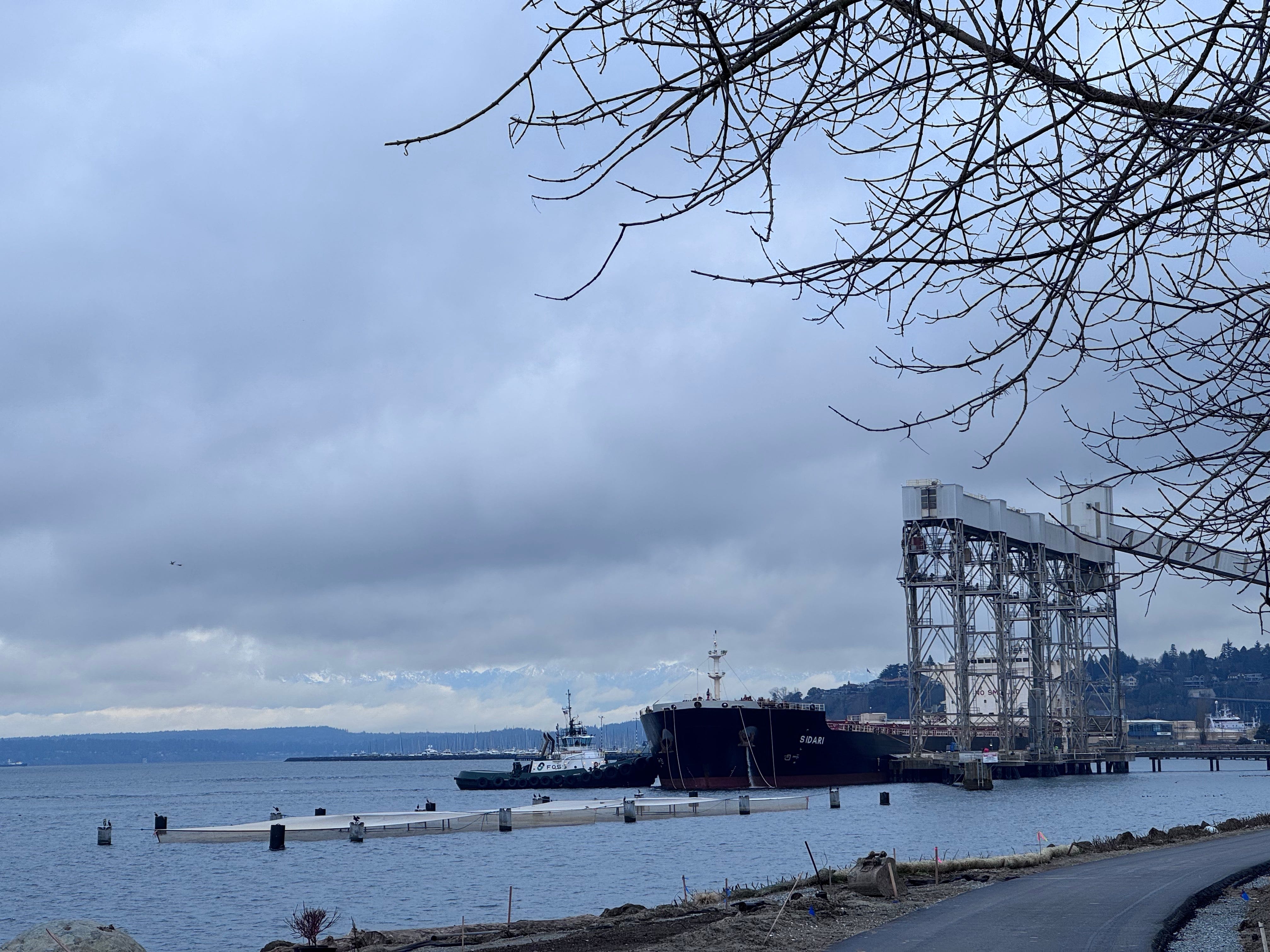
As I was walking home from coffee at the Edgewater I noticed a pair of tugs moving parallel to me along the bay. I assumed correctly they were headed to the grain terminal to push out a bulk carrier and push in another. The grain elevator is a prominent feature along the bay. I love walking by. I marvel at its capability to accept trains and trucks to load grain cultivated in the region and ship it to Asian ports. I always look up the ship’s registration and destination. When the facility opened in 1970 a Greek ship transported wheat to Japan. Today’s ship was registered in Malta and heading to Korea. Based on its Plimsoll line I surmised it was ready to depart.
I became aware of Plimsoll lines while walking with my father along the harbor in Bristol, England. As we passed by a bronze bust on a pedestal he took an interest in the inscription. It was a bust of Samual Plimsoll. In the 19th century sailor deaths were out of control due to unseaworthy ships. Plimsoll introduced a bill to require a way to insure that overloading did not cause disaster. Thus the line along the hull of ships was made an international standard. You won’t miss it the next time you look at a hull. Plimsoll was an extraordinary reform campaigner who’s life is worth a study. Taking note of ships crews and cargo makes me feel connected to all of the interdependencies we have as humans, regardless of our differences.
When the grain facility was built there were heated arguments about every aspect. What wasn’t argued was that farmers were growing wheat and it would be shipped to the world. Today the city is completing a refurbishment of the green space along the bay. The pedestrian and cycle paths, complimented with sculptures dedicated to the history and nature of the shoreline, will be all new by May. Visible from the path (official name is Elliott Bay Trail) I can see Mt Rainier and the Olympic range with little obstruction.
Next along my walk, in stark contrast to the mechanism for loading grains, is the headquarters campus of Expedia Group. Through the profits of 20% of the U.S. travel market they have built a campus incorporating biophilic design principles for more than 5000 employees on 40 acres of waterside land. It is clearly designed to flow from modern glass and steal into lush green space and on to the sea. Well-being of the working staff and the approval of the public were a major design goal. I love the look but the security fence ruins the intent for me.
The end phase of my walks always includes a climb. I live at the top of a 450 ft glacial rise called Queen Anne Hill. There are 120 public stairways leading up (or down) to choose a path home from. Along Wheeler St. from the west or Galer from the east more than 500 steps aid walking accents. At some point I will have climbed them all.
Plimsolls are classic lightweight athletic shoes featuring a canvas upper and a flat rubber sole, originally developed in the 1830s as beachwear. Known for their simple design, they are often used for school PE.
Invented by the Liverpool Rubber Company in the 1830s, they gained the nickname "plimsoll" in the 1870s because the colored horizontal band joining the sole to the upper resembled the Plimsoll line on a ship’s hull.
Always a delight to read your stories. I’ve never been to your bay but feel Iike I can see it.